The 7-Criterion Niche Scorecard (Free)
Leave with: a scored, evidence-labeled niche decision above the 24/35 threshold, ready for a 30-day test.
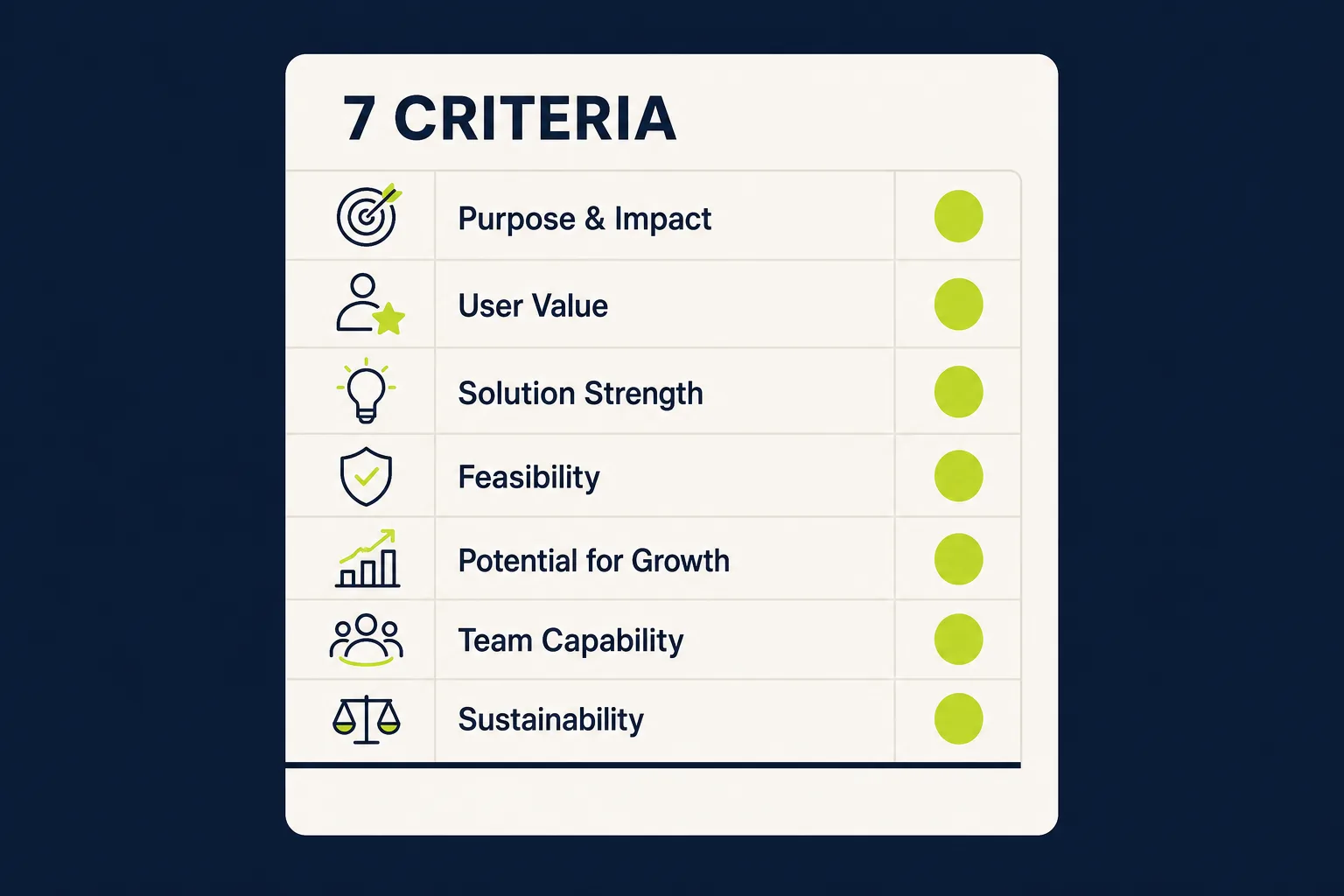
Most niche advice is a feeling: “you'll know it when you feel it.” That gets beginners into trouble, because a high commission feels great and a niche you cannot honestly serve is a slow-motion disaster. The scorecard is the antidote — seven criteria, each scored 1-5, every score carrying a labeled reason. It won't guarantee success, but it stops you mistaking a good commission for a good reader problem.
Why a Scorecard Instead of Vibes
A scorecard does not predict success. It prevents a specific, expensive mistake: committing thirty days to a niche on a feeling instead of on what you can actually observe and learn. When you are choosing a niche, you are choosing a category — the shelf, not one bottle on it. The shelf has to be wide enough to hold a year of helpful pages. A scorecard forces you to check, before you build, whether the shelf has real readers, whether you can learn the topic, and whether you can write about it honestly.
The deeper reason: a score without a reason is a coin flip wearing a clipboard. The numbers only matter because they sit beside the reasons. The reasons are the score; the numbers are just a quick way to see them side by side. That's why every score in this card gets a labeled sentence, not a bare digit.
The Seven Criteria
Score each criterion 1 (weak) to 5 (strong). These seven come from the kit's Phase 1 scorecard, and they cover the full shape of a winnable niche:
| # | Criterion | What it asks |
|---|---|---|
| 1 | A specific reader has a recurring problem | Is there one identifiable person who keeps hitting this wall? |
| 2 | I can name 20 useful questions they'd ask | Is there enough depth to write many pages, not one? |
| 3 | I can learn enough to be accurate | Can I get from beginner to trustworthy in a reasonable time? |
| 4 | Products/services are relevant but not the whole story | Is the niche bigger than a product list? |
| 5 | I can write pages without faking experience | Can I be honest about what I've tested vs. not? |
| 6 | The topic's safety/legal risk is manageable | Any medical, financial, legal, or safety landmines? |
| 7 | I would still care about this after 30 days | Will the curiosity survive the grind? |
Criterion 5 is the one beginners want to skip, and it is the one that keeps you honest. If you cannot write about a topic without inventing experience, either the niche is wrong or the page must honestly say “I have not tested this.” A sourced comparison is a legitimate page; a fake review is a lie.
Every Score Gets a Sentence Labeled Evidence, Hypothesis, or Unknown
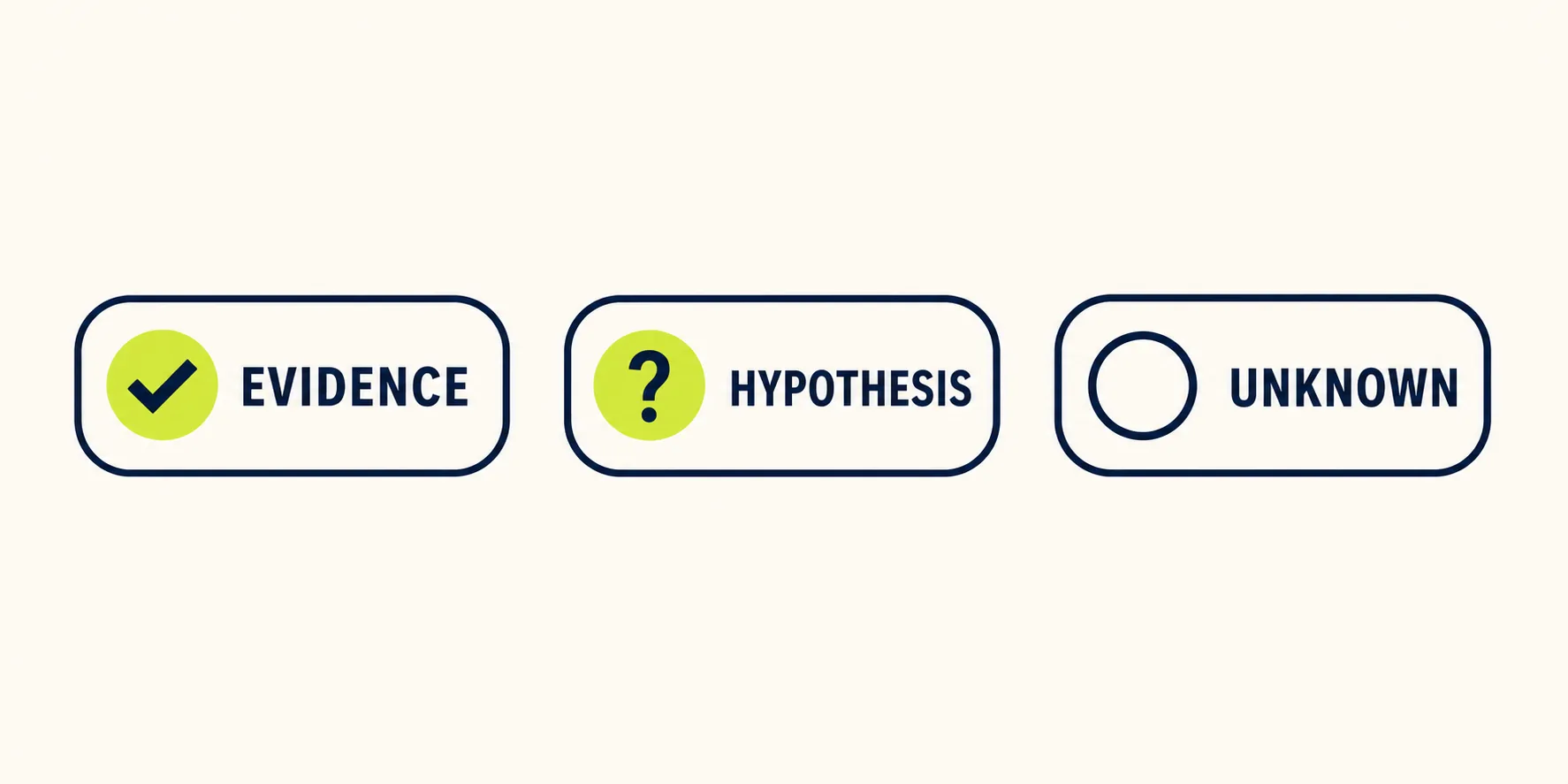
The rule: never write a number without its sentence. For every criterion, one short sentence, labeled by how sure you are:
- Evidence — you observed it directly. “I searched the forums for an hour and found daily threads on this exact problem.”
- Hypothesis — you believe it but haven't confirmed it. “I believe I can name 15-20 recurring questions; two are unconfirmed.”
- Unknown — you genuinely don't know yet. “I have not tested this product, so I don't know if I can write honestly about it.”
The label does the real work. An “evidence” score is solid; a “hypothesis” score is a bet you can test in a week; an “unknown” is a flag telling you what to investigate before you commit. The scorecard is allowed to have shaky numbers — as long as the shaky ones are labeled and aren't quietly doing the work of the steady ones.
This is also the discipline the whole kit runs on: the source-packet method labels every fact as verified or needing verification, and the scorecard is where that habit starts. Score with evidence, or say clearly what you believe and what you don't know.
The 24/35 Threshold
Add the seven scores. The floor is 24 out of 35. Above that, the niche is worth a 30-day test. At or below it, say so plainly, name which criteria failed, and score two or three adjacent niches instead. A red rule: any criterion scoring 1 or 2 must be investigated before you proceed — that's what “unknown” means, and the fix is to go find out, not to round the number up. The threshold exists to catch you before you build a month of pages on a niche whose weak spot is fatal.
And do not flatter the idea. A 24 is a 24. If you find yourself arguing with the rubric to save a score, the friction is signal — the topic that needs excuses is usually the topic you'll abandon in week three. Three scored topics is enough; after that, write one page and see how it feels.
The Four Filters: Which Weakness Wins
The seven criteria tell you whether the niche is worth testing; the four filters tell you where to look first. They are not gates to pass all at once — they are a way to notice which one is weakest, and the weakest filter names what to investigate first.
- Price. Is the average sale high enough that the commission is worth the work? A niche with a $20 sale and a 2% commission is a lot of effort for forty cents.
- Buyer. Does this reader have the money and the inclination to actually buy? A niche that fails this is a niche where you write help nobody pays to read.
- Brand domination. If the buyer already knows exactly which brand they want, your comparison page has no job to do. You need the corner where brand pages don't answer the real question.
- Serve-ability. Can you actually fulfill the promise — get approved for the programs, and write about it honestly? A niche you cannot be approved for is a niche you cannot serve.
Run all four, then focus on the weakest. That's where the uncertainty — and the real risk — lives.
The Carve-Down Rule

A niche must be a category, not a single product — and it must be carved down to one frustrated person. This is the rule that keeps you from trying to be a shelf for everyone.
- “Home office setup” is too big → carve to “home office setup for a renter in a small apartment.”
- “Gardening” is too big → carve to “vegetable gardening on a small city balcony.”
- “Dog training” is too big → carve to “teaching a golden retriever puppy not to pull on the leash.”
Notice what each carve does: the topic turns from a label into a person with a problem — and a person with a problem is the reader you can write a year of pages for. If a topic cannot be carved down to one addressable reader, it is a cloud, not a niche. The carve is not a detail; it is the whole method in miniature.
A Worked Demo: Tenant Coffee Scored 29/35
To show you how the card works end to end, here is our own demonstration run — the Tenant Coffee demo from the kit's example site. This is honestly labeled: it is our own demonstration run, a sample, not a real launch. The evidence labels are illustrative examples of how a real run labels its observations, not facts we observed in the wild. We scored “home coffee gear for apartment renters”:
| # | Criterion | Score | Label + sentence |
|---|---|---|---|
| 1 | Specific reader, recurring problem | 5 | Evidence. Coffee forums host daily “best setup for a small kitchen” threads; “apartment” and “counter space” recur. |
| 2 | 20 useful questions | 4 | Hypothesis. Confident of 15-20 recurring questions; a couple are niche-edge. |
| 3 | Can learn to be accurate | 4 | Hypothesis. Well-documented technical literature; hands-on testing is the limit, not the knowledge. |
| 4 | Products relevant, not the whole story | 4 | Evidence. The recurring ask is technique and workflow, not just “which brand.” |
| 5 | Can write without faking experience | 3 | Unknown. Comfortable with sourced comparison, but never lived in a tiny apartment with a Bambino — must state it. |
| 6 | Safety/legal risk manageable | 4 | Evidence. Low-stakes consumer category; no medical/financial/legal claims; one material electrical-safety note. |
| 7 | I'd still care after 30 days | 4 | Hypothesis. Testable by writing the first article and noticing if the second feels like a chore. |
Total: 29 / 35 — above the 24/35 floor. No criterion scored 1-2, so the rules say proceed. Criterion 5 (faking experience) is the explicit weak spot, named as the article-by-article limit, not a reason to abandon the niche. The four filters: price is moderate (grinder $100-$400, machine $300-$700; on broad Amazon that's 1-4% commission — a niche program with real rates matters), buyer is strong (renters 25-40 spend on gear that survives moves), brand domination is partial (Breville and Baratza are default-considered, so the site's job is the intersection — size + noise + renter realities — those brand pages don't cover), and serve-ability is strong (approval is achievable on a live site; limits handled by the source-packet method). Weakest filter: price — the first thing to investigate. The carve-down: from “home coffee gear” to “café-quality coffee for apartment renters with limited counter space and a tight budget.”
That demo is deliberately honest about its weak spots — criterion 5 and the price filter — because that honesty is the point of the method. A 29/35 is not a guarantee of anything; it is a decision to spend 30 days testing one carved niche with your eyes open.
The Next Step
Your next step: score one niche tonight. Open the free 7-criterion scorecard, pick the topic you keep circling, and fill in all seven rows with a 1-5 number and an evidence/hypothesis/unknown sentence. Then apply the four filters, name the weakest, and carve the topic down to one frustrated person. If you can't finish both halves of this sentence — “the strongest reason to test this for 30 days is ___; the strongest reason to pause is ___” — the card isn't done. That single filled-in card beats a week of thinking about niches.
Want the whole method, scored for you and built into a working site? The Affiliate Agent Kit runs Phase 1 as a guided scorecard with the filters and carve-down, and the Learn hub has the deeper research side — including the source-packet method that keeps your content honest and the AI-vs-human split that governs what you write in whatever niche you pick.
Results vary. Affiliate marketing involves effort, learning, traffic acquisition, and compliance. Earnings are never guaranteed.
Results vary. Affiliate marketing involves effort, learning, traffic acquisition, and compliance. Earnings are never guaranteed.