What an Affiliate Marketer Actually Does All Day
Leave with: a realistic week of the five real jobs — research, content, promotion, testing, compliance.

When the hype pages describe affiliate marketing, nobody is ever shown doing the work. The honest version is less glamorous and far more real: an affiliate marketer is a researcher, a writer, a promoter, a tester, and a compliance officer — often all in one week. Here is what that actually looks like, day to day.
The Five Jobs in One
Strip away the income screenshots and the “passive income” headlines, and an affiliate marketer is someone who does five distinct kinds of work, over and over:
- Research — finding out what readers actually ask, which products they would honestly consider, and which programs pay for those recommendations.
- Content — turning that research into useful pages that genuinely help a reader decide.
- Promotion — getting those pages in front of readers through search, communities, social, or email.
- Testing — checking which pages help, which links get clicked, and what to update or abandon.
- Compliance — keeping the disclosures honest, the claims verified, and the program rules followed.
None of these is a one-time task, and none is glamorous on its own. What makes the job real is the loop: research feeds content, content needs promotion, promotion produces data for testing, and testing tells you what to research next. Compliance runs underneath the whole loop, quietly. This is the honest shape — a cycle of small, repeatable, mostly unexciting tasks — not a single dramatic action that unlocks wealth.
A Realistic Week, Not a Fantasy Day
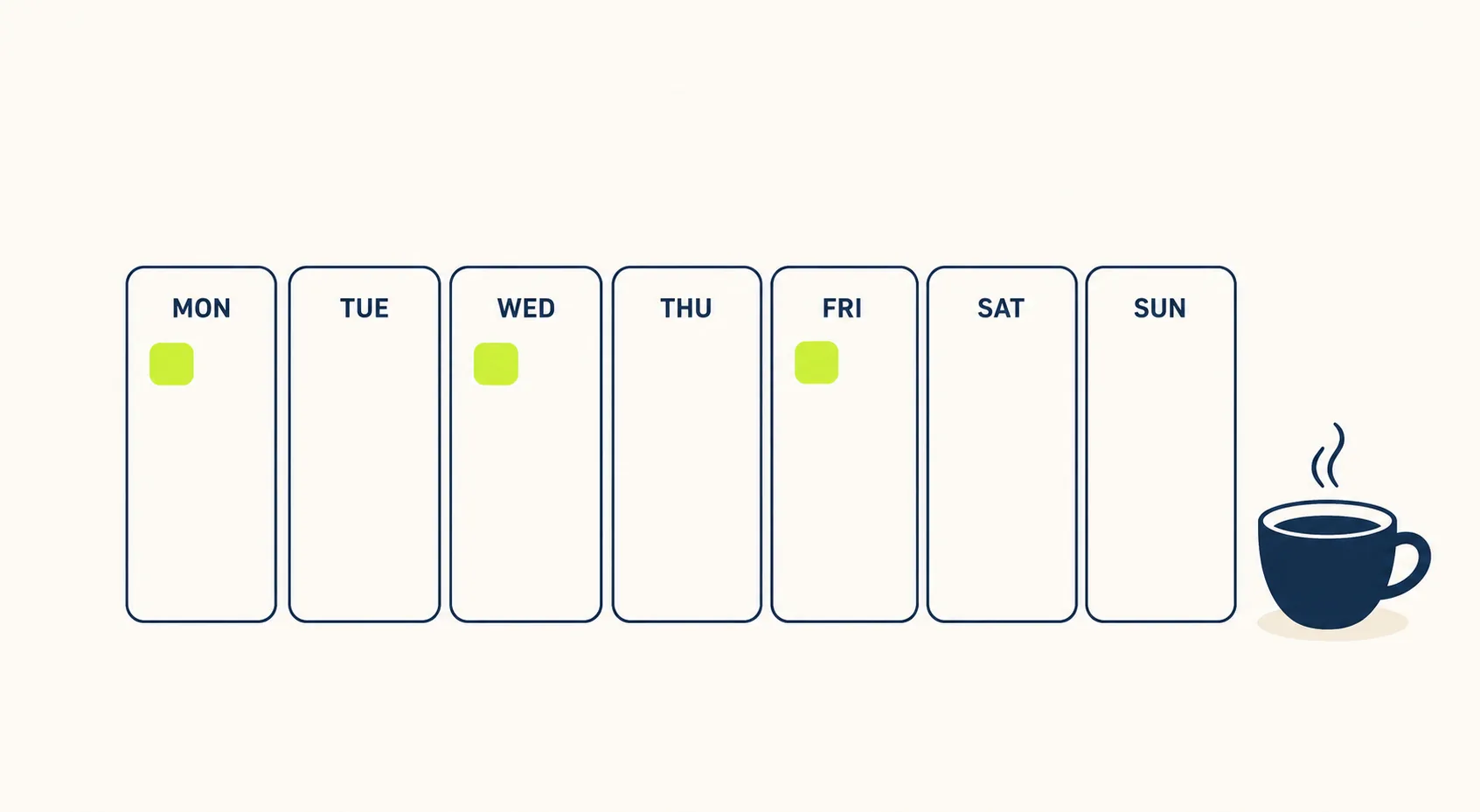
No two affiliate marketers work the same week, but a realistic one has a recognizable rhythm. It is not a day of “lightning-fast cash.” It is closer to a steady cadence of small tasks, most of which do not look like “marketing” at all:
- Monday — research. Spend the session on one reader question. Find ten products a real reader would consider while answering it, and check each one's footer and search for its affiliate program. Record what you find: program name, direct or network, URL, date checked.
- Tuesday — content. Take the research and draft one page that genuinely helps a reader choose. Not a sales pitch — a useful comparison, an honest review, or a tutorial that names real trade-offs.
- Wednesday — verification and compliance. Re-read the draft for every claim that could rot: prices, program terms, specs, anything about money or safety. Confirm the disclosure sits immediately before the first recommendation, and confirm the qualifying action you wrote matches the program's actual terms.
- Thursday — promotion. Publish the page, then share it where your reader actually is — one relevant community, one social post, or one email to anyone who subscribed. Small, honest distribution beats a spam blast.
- Friday — testing and the evidence check. Look at the five numbers that matter for a young site: visits, email signups, affiliate clicks, conversions, and pages updated. Write one sentence about a hypothesis you now believe, and one about what you got wrong. Update one old page if anything rotted this week.
That is a full, honest week — and the honest truth is that most weeks do not include a commission. The work is the compounding asset; the commissions are the occasional fruit of it. A beginner who expects every week to end in a payout will quit during the months where the only output is a growing pile of useful pages. The realistic frame is the one that survives.
Research: The Job Under All the Others
Research is the least visible and most important of the five jobs, because every other job is only as good as the research under it. The discipline is to start from real reader questions, not from a product you want to sell. Ask what a reader in your niche is genuinely trying to figure out — “why does my espresso machine keep clogging?” beats “best espresso machines 2026.” The long, specific question carries its own intent: the reader already told you half the job by asking it.
Under each question, list the products a real reader would actually consider while answering — not the best product, the honest one they would weigh. Then find the affiliate program for each: the footer check (look for “Affiliates”, “Partners”, or “Ambassadors”), a plain search for “[product] affiliate program,” and the professional move of reading a competitor's outbound link to see which network it rides. This is the loop that turns “affiliate programs exist somewhere” into a list of ten real programs with real URLs and dates — evidence you can cite and re-check, rather than a guess.
Content: Where the Value Actually Lives
The content job is where the model either becomes legitimate or quietly stops being so. A useful page helps a reader decide — it names trade-offs, is honest about what it does not know, and leaves the reader more capable than it found them. That last part is the test that matters: if a reader could use your page and thank you even with every affiliate link removed, you have written the compounding kind of content. If the page exists only to carry the link, you have written the fragile kind.
The best content is built from the franchise frame: you supply the customer, the merchant handles the product and shipping. That means your page is a front door, not a store — your job is the quality of the reader's decision, and the honest disclosure sentence (“I may earn a commission if you buy through my link — at no extra cost to you”) sits right beside the first recommendation. A reader who knows the relationship and trusts you anyway is the reader who comes back.
Promotion and Testing: The Loop That Compounds
Promotion is not about shouting louder; it is about putting one useful page in front of the reader who needs it. For a beginner, the honest first traffic source is the pages themselves — organic search and the communities where your reader lives. That traffic is slower than paid ads, but it is free, and the only budget it spends is your time. Paid traffic is usually wrong for a beginner for a real reason: the economics are stacked against someone who has not yet built a funnel, and the commission payout lags far behind the ad spend. Let the reader find you; the compounding is the point.
Testing is the part beginners skip, and it is the part that turns effort into learning. A young site does not need seven dashboards; it needs five numbers — visits, email signups, affiliate clicks, conversions, and pages updated — and a weekly note with one hypothesis that could be wrong. That weekly evidence check is the difference between doing the work and learning from the work. One week of traffic is weather, not climate; low numbers on a new site are a sample, not a verdict.
Compliance: The Quiet Job That Keeps You Alive
The compliance job is the one nobody advertises, and it is the one that decides whether the site is still standing next year. It has three pieces, all small and all recurring:
- Disclosure placement. The plain-language disclosure sits immediately before or beside the first recommendation — not only in a footer. A footer disclosure is a disclosure in a different room than the recommendation. (The full placement rule is in our guide to disclosure placement.)
- Claim verification. Every claim that could rot — prices, laws, specifications, program terms, anything about health, money, or safety — needs an inspectable source before it goes on the page. A confident sentence about an unverified number is the exact kind of content that gets a beginner in trouble. Confidence is not evidence; it is a font choice.
- Program-term hygiene. Programs change their rules, their commission rates, and their required wording with little warning. Reading the official terms on the day you act, and re-checking them when you update, is the job. If you cannot remember when you last read a program's terms, that is the answer: it is time to re-read them.
None of this is exciting, and all of it is what separates a durable site from a corrected one. Platforms and regulators clamp down on deceptive content, and a single unflagged claim can cost months of work. The compliance job is not a tax on speed; it is the cheapest insurance a site whose only asset is its reputation can buy.
What the AI Agent Takes Over — and What Stays Human
Here is the part the job descriptions never mention: a large share of the repetitive work can now be delegated to an AI agent — and a specific share cannot, and should not. Getting the split right is what separates a calm workflow from a mess.
The agent can take over the mechanics: consolidating research into an outline, drafting a first version of a page from facts you supplied, generating the boilerplate trust and policy pages, planning a content map, and running a 30-day publishing rhythm. It is fast, never gets bored, and is excellent at the repetitive parts that would otherwise eat your week.
The agent cannot take over the judgment, and this is the boundary that keeps the site honest. It cannot tell a reader what it actually felt like to use a product, what surprised you, or what you wish you had known before you started — those sentences are yours alone, and they are the ones that make a small site feel human. It cannot decide what counts as a real recommendation from your own experience, sign your name to a disclosure, or hit publish with the accountability that comes with it. And the agent will confidently make things up if you let it — which is why feeding it a source packet of facts you actually verified, then running a verification pass on its output, is not optional. The agent writes; you verify; you are the one who hits publish.
The honest division of labor is simple: the agent handles the mechanics, and you supply the voice, the judgment, and the honesty. It reduces busywork and creates better systems; it does not replace fact-checking, product experience, compliance judgment, or editorial review. A one-person shop that gets this split right can produce work that reads like a small team — because the agent does the team-sized mechanics, and you do the human part that no team can fake.
The Next Step
The work, honestly, is a loop of small tasks — and your next step is to run the loop once, at the smallest scale. Pick one reader question you can answer better than the current results, list three products that reader would honestly consider, and check each one's footer for its affiliate program. That is research; that is the whole day-one job. Do not plan the content empire yet — the loop is learned by running it, not by reading about it.
Want the structure to turn that research into a first useful page — with the trust pages and disclosure built in from the start? The Affiliate Agent Kit walks you through it, and the Learn hub has the plain-language pieces, including how the model actually works and how to buy your first domain without the upsells. Or just run the one-question loop now — the work is real, the rhythm is learnable, and the compounding is the whole game.
One honest CTA: run the one-question research loop today. Ten minutes, one real reader question, three products, three footer checks. That is what an affiliate marketer actually does — and now you are doing it.
Results vary. Affiliate marketing involves effort, learning, traffic acquisition, and compliance. Earnings are never guaranteed.
Results vary. Affiliate marketing involves effort, learning, traffic acquisition, and compliance. Earnings are never guaranteed.