Affiliate Disclosure Placement: What the Rules Actually Expect (and Where Most Sites Get It Wrong)
Leave with: a five-minute audit that moves your disclosure beside the first recommendation, not just the footer.

The single most common affiliate-site trust mistake is not whether you disclose — it is where. A disclosure buried in the footer is a disclosure in a different room than the recommendation, and a reader who meets the recommendation never meets the disclosure. Here is what the rules actually expect, in plain language.
The Non-Negotiable Placement
The plain-language affiliate disclosure sits immediately before or beside the first affiliate recommendation — not in a footer, not in a dropdown, not in faint text, not in a separate universe.
Why there? Because that is the moment the reader is deciding whether to act on a link, and it is the moment the reader most needs to know the relationship. A recommendation and its disclosure are a unit. If a reader meets the first affiliate link on your page and does not see the disclosure until they scroll to the bottom — or never scroll — then the reader was never actually disclosed. The placement rule exists so the disclosure is physically impossible to miss at the exact moment it matters.
The FTC treats undisclosed material connections as the core deception to avoid in endorsements. An affiliate link is a material connection: you may earn a commission if the reader buys. Disclosing that next to the recommendation is what the rules expect. (This is practical guidance, not legal advice — the FTC's guidance documents are the place to verify current expectations.)
The Footer-Only Mistake
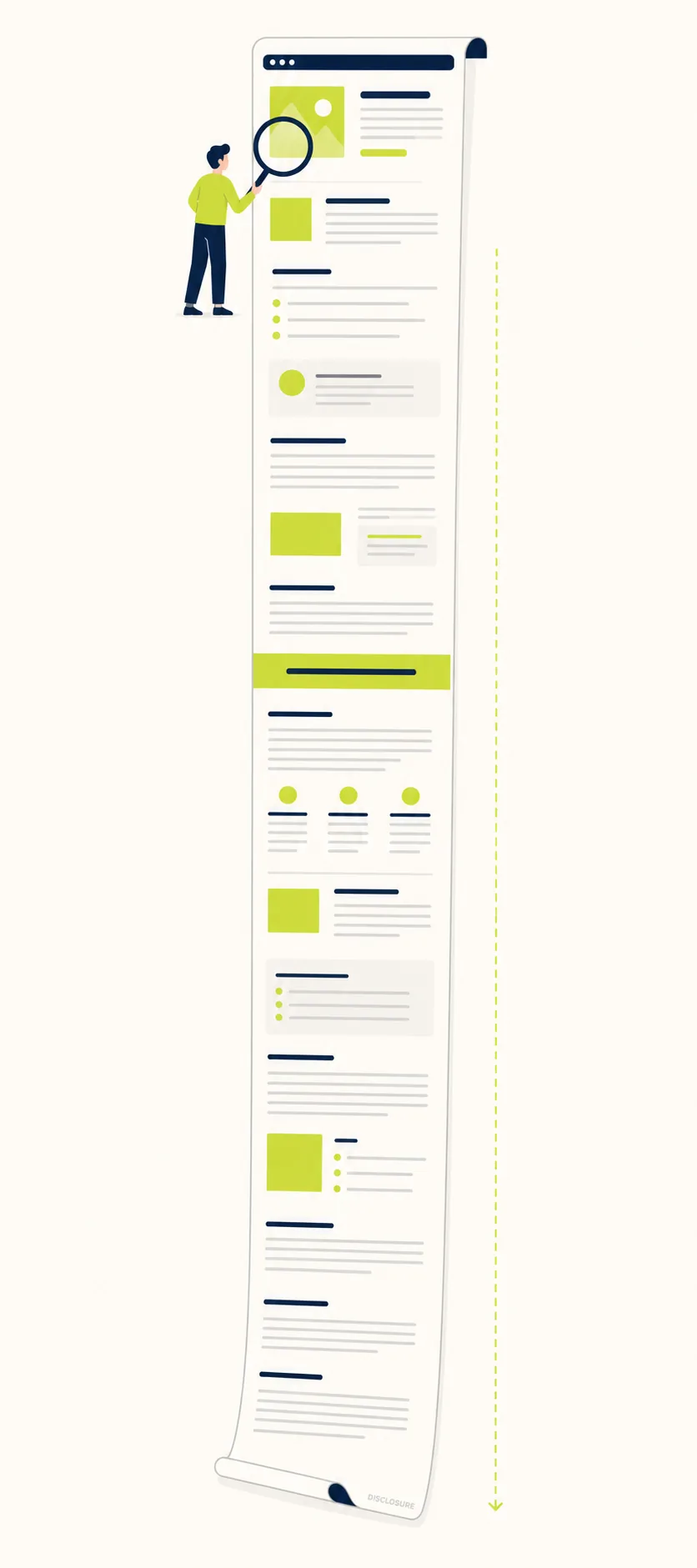
The most common failure is not a missing disclosure at all — it is a disclosure that lives only in the footer (or in a dropdown, or on a dedicated page reached by a faint link). A footer disclosure is technically present and practically invisible.
The test is simple: read your page the way a reader reads it, top to bottom, and ask whether the first affiliate link and the disclosure are in the same visual moment. If the answer is no — if the reader has to hunt for the disclosure, or never sees it — the placement is wrong, no matter how complete the footer text is. The fix is not to write more words; it is to move the sentence to where the first recommendation is.
The Standard Sentence
The kit's default disclosure — and the complete disclosure for most readers — is:
"This site contains affiliate links. If you buy through them I may earn a commission at no extra cost to you."
That sentence is the floor. It tells the reader what the relationship means in plain words: you may earn, they pay nothing extra. It is short, honest, and it does the job on its own for most pages. If you are not sure what to write, this sentence is a safe, correct default.
Program-Specific Wording: Added, Not Substituted
Some affiliate programs require their own disclosure wording on top of the plain sentence. Amazon's agreement, for instance, requires the clear and prominent statement "As an Amazon Associate I earn from qualifying purchases." [VERIFY — recheck program terms at publish, as agreements change.]
The rule for program wording: added next to the plain sentence, never instead of it.
The plain sentence tells the reader what the relationship means; the program phrase satisfies the program's contract. Two short sentences side by side do more for trust than a paragraph of legalese buried three pages deep. When you are approved for a program that requires specific wording, place its phrase adjacent to the standard sentence — not as a replacement, and not only on a far-away disclosure page.
This matters because the two sentences do different jobs. If you substitute the program phrase for the plain sentence, you may satisfy the program's contract while failing the reader's need to understand the relationship. Keep both, side by side.
Where the Disclosure Lives, Page by Page
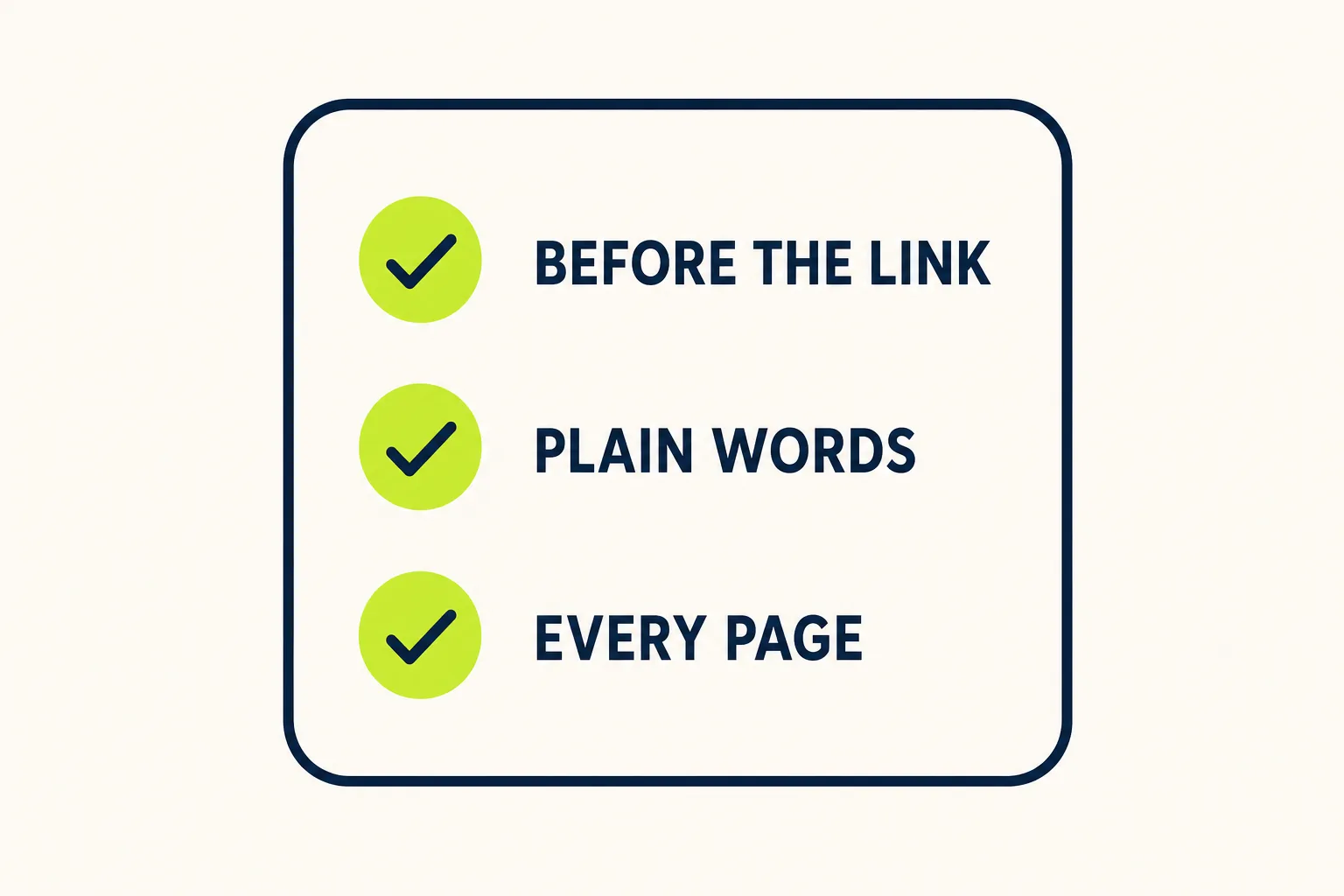
The beside-the-first-recommendation rule is the one that matters most, but it is not the only place the disclosure belongs. Three locations work together, and each has a distinct job:
- Article page. The disclosure sits immediately before the first recommendation slot. This is the one the reader meets at the moment of the recommendation — the one that does the real trust work.
- Site-wide disclosure page. A dedicated
disclosure.htmlrestates the plain sentence and names the programs you promote, each with its network. This is where the full picture lives for any reader (or regulator) who wants it. When you get approved for a program, you fill in the program name and network markers here. - About / editorial policy. The relationship type is named plainly — commission, free sample, anything of value — so the reader can see the whole shape of how the site earns.
The article-page disclosure is the non-negotiable one; the other two support it. A site with only a disclosure page and no inline disclosure has failed the placement rule even though it has plenty of words.
The Post-Approval Link Swap
Disclosure placement is not a one-time setup — it is something to re-check the moment your affiliate link changes. Here is the scenario: your site ships with {{YOUR_LINK_n}} placeholders where the real links will go. Your affiliate application gets approved, and your program dashboard shows a real URL that is uniquely yours. The job now is the post-approval swap: replace each placeholder with its real approved URL, and then re-check that every disclosure still sits immediately beside the first recommendation it protects.
Three rules make the swap safe:
- You supply the real URL — the agent never invents one. Your dashboard shows the URL; you read it off and hand it to your agent. An invented affiliate URL is a link to nobody and a lie the reader can click.
- One URL per slot. Do not point both slots at the same product unless that is genuinely what you recommend. A slot still waiting on approval stays a visible placeholder — a visible placeholder is honest; a fake URL is not.
- Re-check the disclosure after the swap. Swapping a URL must not shift the disclosure block. If any layout change moved it, put it back. The disclosure and the first recommendation are a unit; keep them adjacent.
One option worth knowing: a go/ redirect folder. If you want your links to read as yours rather than as a long raw affiliate URL, you can build one small redirect page per link (go/espresso-machine, go/grinder), each pointing at the real URL recorded once, and point every site link at the local go/ path instead. The benefit is maintenance: when a product is discontinued or an offer dies, you update one redirect and every page that uses it points at the new, honest destination — no orphaned raw URL on every page. It is a practice to name and follow, not a mandate to buy any particular tool.
The placeholder convention is itself a trust feature: your site never ships a fake link, and a reader can see that a slot is waiting for a real URL after approval. The swap closes the bridge — but it must not move the disclosure while doing so.
The Disclosure Review Date
Your approval added a program; it did not freeze the disclosure. Every disclosure line should carry a freshness date — the date you last verified the wording. Treat it like a habit, not a timestamp from a tool you never open. The moment you stop knowing when you last verified the disclosure wording is the moment it starts drifting out of date.
Programs change their required wording, their commission structure, or their rules with little warning. When one does, it is a small, named update: open the program page, read the current required disclosure phrase, and swap the program-specific sentence on every page that carries it — next to the plain sentence, never instead of it. The plain sentence rarely changes; the program line is the one that needs re-checking. If you cannot remember the last time you read a program's terms, that is the answer: it is time to re-read them.
The Next Step
Your next step is a five-minute audit: open your most-trafficked page (or your first page, if you are still building), find the first affiliate link, and confirm the plain-language disclosure sits immediately before or beside it — not only in the footer. If it is in the footer, move it. That single move does more for reader trust than any amount of polish.
Want the disclosure sentence, the program-specific wording structure, and a template ready to paste? The Affiliate Agent Kit builds the disclosure block into every page template — structurally forced to sit above the first recommendation — and includes the disclosure generator for the program wording. Prefer to keep learning? The Learn hub has more, including our guide to keeping AI from lying on your site, since honest content and honest disclosures are the same trust-building habit.
One honest CTA: run the audit on one page right now. Find the first link, check where the disclosure sits, and move it if it is not beside the recommendation. It takes five minutes, and it is the cheapest trust repair on the internet.
Results vary. Affiliate marketing involves effort, learning, traffic acquisition, and compliance. Earnings are never guaranteed.
Results vary. Affiliate marketing involves effort, learning, traffic acquisition, and compliance. Earnings are never guaranteed.